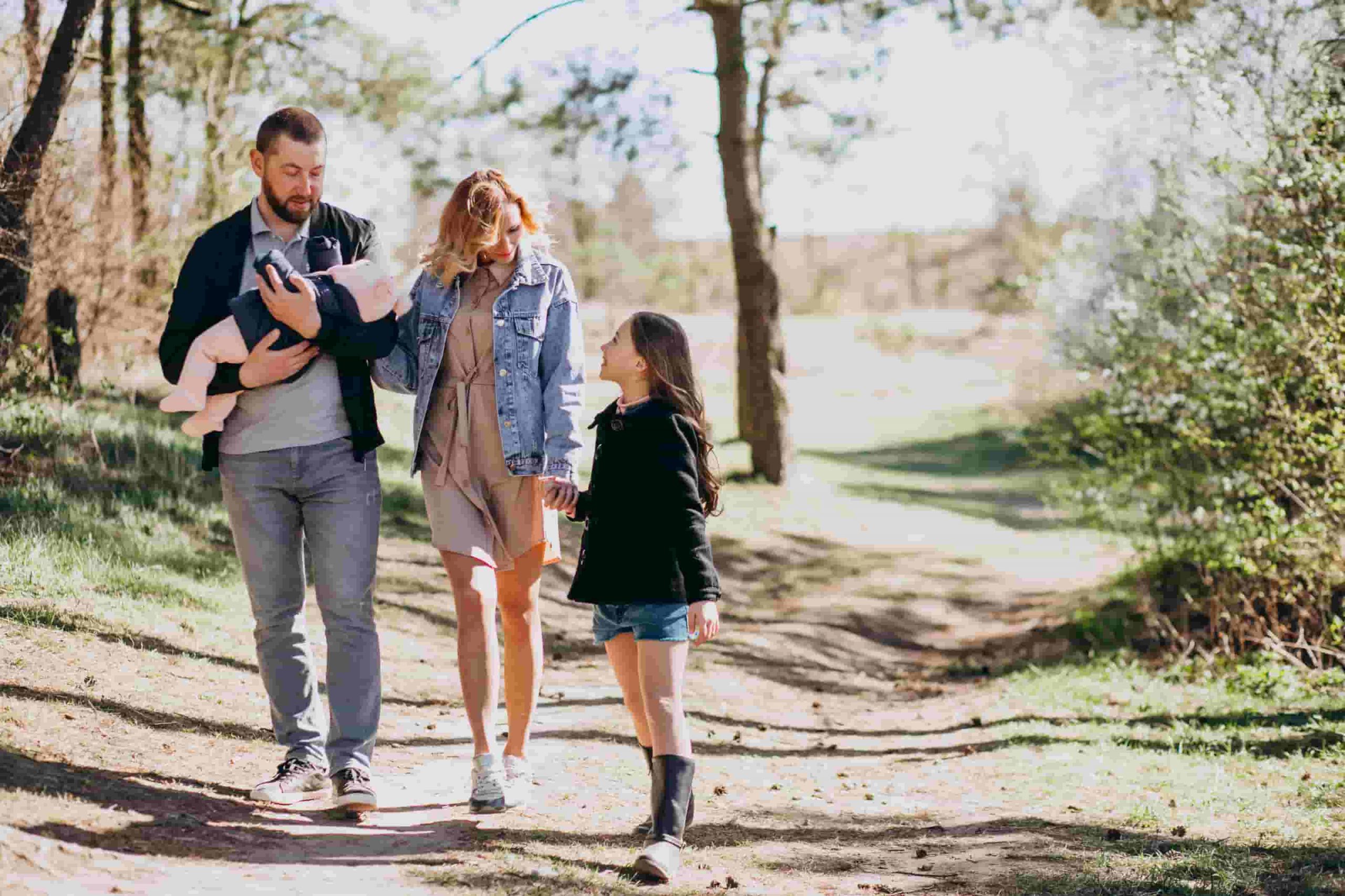
A Family Clue Walk is a very simple activity; however, there are many things that can go wrong with planning a clue walk. A route that is too long, written clues that require reading, and a finish that is not clearly marked are just a few things that can bring forth a lot of negative comments. However, with some careful planning a clue walk can provide a fun activity for all ages in which each participant can solve their own clues while traveling along with the rest of the family on a route that you have chosen. Here is how to plan a clue walk for activities like Door County family activities.
Start with a route children can understand
The design of the route can precede the design of the individual clues. The designer would look for a relatively small, circular route that starts from a highly visible location. The designer would look for a number of highly visible 'landmarks' along the route. These can be benches, signs, large trees, fences, viewpoints etc. They can be man-made or natural but they must be highly visible all of the time. In short, choose a route that allows children to follow it in order to complete the clues and have fun along the way.
When determining the length of your route for your family activity, be sure to keep in mind the smallest child in the group. Remember that you will want to allow for plenty of time for your participants to complete each stop and to spend time together as a family at the end of the hunt. In general, a shorter route with more pauses throughout is better than a very long route with many clues along the way.
View the family activity route from a child's perspective. Determine if clues can be read from the ground whilst following the designated path. Observe if any landmarks may be confused with others and revise corresponding clues or pick alternative features along the route.
Build a clue ladder instead of one difficulty level
Treasure hunt clues can be written in a variety of ways to create a ladder of difficulty for family members of different ages. Look-and-find clues, counting clues, choice clues, word clues and sequence clues are all examples of clues written for children. Each type of clue provides a fun and challenging activity for the different ages of family members. For example, look-and-find clues enable younger children to look for something with certain characteristics such as a red object.
Use a mixture of clue types:
– Look-and-find clues: Look-and-find type clues where children of different ages can search for different things like colors, shapes, textures or objects that they recognize.
– Counting clues: Counting is only suitable for clues with small and visible quantities which won't change while you are solving the clue.
– Choice clues: Give them several possible places to end the adventure and include enough information to rule out a few of them.
– Word clues: Use simple reading, letter matching, or a short anagram for children who enjoy language puzzles.
– Sequence clues: At the next stage, people can look for what comes first, next or last on the route.
Avoid clues that rely on knowledge that children cannot share, very small print, complex math problems or reading abilities of individual children. Ensure that any signs left along the route for children to read are at a readable distance and do not encourage children to pick up the clue.
Give each age group a useful job
The clues mean children of different ages can help in various ways without the younger children feeling they are just accompanying the older ones or the older children being bored because the clues are too easy.
Preschoolers: Search for colors, sounds, large shapes and familiar objects. Early readers can match symbols and read a few letters. They can also answer simple questions with two choices. Older children can solve riddles, keep track of the order of clues, read the next direction aloud to the group and check if the group has taken the correct route.
Let adults divide up jobs to keep them interesting. Assign each a role, such as clue holder, landmark spotter, route checker. Let them change roles at each stop to prevent one reader becoming the group's leader.
All clues can be rewritten for mixed age groups by having a main clue and an optional bonus question for the older children. This ensures the older children are able to use their problem solving skills to search for additional details within the clue and to explain their reasoning to the other children in the group.
Make the finish obvious and satisfying
The end should be obvious, providing a meeting point, somewhere to have a picnic or the location of a public feature that forms the end of the hunt and where families can gather without causing a blockage or having to search for something in the undergrowth. Remember the end should be obvious so there is no chance of the children wandering off in search of a dramatic reveal.
Word the final clue in such a way that upon reading it the family will know that they are in the right place e.g. "Here is the wide stone edge to the path and you are at the end of the scavenger hunt."
Decide beforehand what you will use to celebrate your completion of the activity. This could be a treat to eat, a group photo to be uploaded onto your phones, a token or two of your non-littering behavior, or simply a change to sit and look around and relax after your long and tiring activity. Ensure that anything you decide to leave behind does not become litter and cannot cause confusion at a later date. Try to find items that are reusable.
Keep the hunt responsible and adaptable
Ensure responsible exploring is inherent in your chosen clues. Encourage children to take different paths, to explore existing viewpoints, to search for plants, rocks, wildlife and historical features – without picking, digging, climbing, feeding or moving them. Be aware of other visitors and ensure the group is doing nothing to jeopardize their safety or experience of the same location.
Always check current public area information before going out, for example for new access restrictions, closures, for places where pets are not allowed, for places where you are not allowed to make a fire, for collecting etc. Information changes due to current conditions and public area management.
Alternative activity for bad weather. You never know what the weather is going to be like and you need to plan for rain, heat, strong wind and poor visibility. A printed version of your activity, a shorter version of your activity or even stopping at the next safe point can all be alternatives to continuing with the original activity.
Test every clue before inviting the group
The biggest mistake with scavenger hunts is that people only test them out as if they were walking the route of the hunt. Get someone else to follow your clues and see if they get to the same destination that you did. See if a child can give a correct answer to a question with more than one correct answer.
Identify how different problems might occur and change clues if they will cause a problem (e.g. the landmark is hidden by parked cars, or a sign cannot be read because of glare; a clue that depends on counting might change as you move around; a clue that tells walkers to go in the opposite direction of what you intend will cause problems).
Bring pens, extra copies of your clues, water and a way to call an end to the hunt if necessary. It is perfectly fine to skip a particularly difficult clue and give the children an extra clue or to move straight to the end of the hunt. An outdoor scavenger hunt is not about making difficult puzzles for children to complete. Measure the success of your event in terms of child engagement, responsible travel and a wonderful time had by all at the end of the hunt.